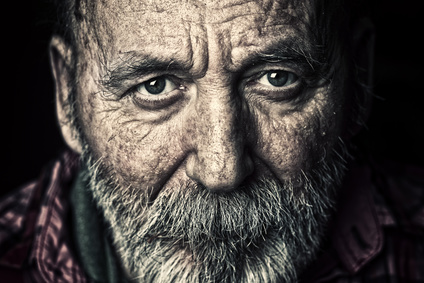
Looking into the eyes you can see the heart and soul of another. We learn to look at people. We learn to look on people. It’s risky to look into their eyes, though. So we learn not to.
You see beautiful things when you really look. You see terrible things, too. The worst is looking into the eyes of someone so guarded that they won’t let you see them. They could be a devil, or they could be deeply disturbed. All you know is that there’s a reason they’re hiding. And that’s reason enough for concern.
The hardest is looking into eyes that are speaking overwhelming volumes, as in the case of my dad who was near death. Unable to speak because his jaw had been lost to cancer he was too weak to communicate any other way. His eyes were full of fear and anguish. And there was apology there. And when I said all I could think to say at the time and attempted to imply there was hope, his eyes softened, and there was the look of giving up. I’m not sure I saw love there, though it might have been overshadowed by the other emotions. The apology was a form of love. And there may have been a flicker of it right before the giving up.
The most surprising is when you look into the eyes of someone who prides himself on being tough and in charge, and being able to manipulate situations and people, and keeping his cards close to his vest, and who is given to verbal fits of anger and other external expressions of the need to control, and you see the hurt, shy child, uncertain about his deepest convictions, who just wants to be loved. And all you want to do is make it all better for him.
The weirdest is looking into the glassy eyes of the religious cultist. His soul seems to have gone on hiatus and been replaced by some external power source. He’s like a human dual-powered Prius. He’s off his gas-fueled engine and plugged-in to a current in a box on a corner somewhere. There are only a few of these stations available, and only to those who are driving the right kind of car. It makes the rest of us very aware of the unique car. It even makes some of us desire to own one of them. Oh. Watch out. They’re very quiet when controlled by the electrical system. They’ll sneak up on you unawares. Don’t get hit.
Not sure how I started talking about cars. And not much about the eyes here. But there’s not much to see or to say about them, until if the person returns from vacation.
The saddest is looking into the eyes of want and despair. And this sounds mean and terrible. But some people do feign want and despair and put on the trappings of the downtrodden. It can be hard to know for sure if we’re seeing a trickster of the worst kind – an unkind, unapologetic soul who has learned to hide – or someone genuinely in need.
People in need show a range of subtle emotions in their eyes. These people are the closest to our humanity. For many months on my way to work, every day I walked by a man who sat with a makeshift crutch and his leg wrapped in rags. We came to acknowledge each other with a good morning and a smile. His eyes seemed always to twinkle in spite of his condition. If he stood, it was only briefly. Then he hobbled on the one leg and his crutch back to his perch. Then, one day I saw him sprint across the busy street on two good legs, calling to someone and waving his crutch in the air. I was stunned. I was upset. I was embarrassed. Giving him the benefit of the doubt, maybe he was mentally disturbed and the crutch and rags were the only way to be noticed for a disability that kept him from living a normal, productive life. But, maybe not.
That subtlety of want and despair. I used to take nightly walks in an extremely safe, well-to-do neighborhood. A woman started appearing, sitting on a park bench with a blanket over her lap and a couple of small knapsacks at her side. She was very tidy and put together. She might have lived there. Seeing her once or twice I didn’t think much of it. But then she was always there. Other people started to figure out that something was up. Occasionally, someone would sit and chat with her. She was articulate, intelligent, stoic. She could muster a smile at the appropriate moment. But I noticed she never made eye contact with anyone. Not with anyone who passed by and said hello. Not with anyone who sat to chat with her. Most of the time, she looked straight ahead into the vast, empty distance and nodded gently up and down in agreement with whatever was going on or being said. You couldn’t catch her eyes. I’m sure those eyes must have been filled with pain, loss, resignation, despair, denial – likely too much. Not making eye contact with anyone probably preserved her last thread of dignity, and kept her surviving from one day to the next.
I’ve always been what I refer to as a “watcher.” But I learned about really looking into the eyes across from me when I studied acting. The big lesson is that seeing into the eyes of someone else unlocks who you are. It frees you to get out of yourself, and to give yourself to the other person and, most important, to absorb who they are and what they’re all about. And it isn’t easy. As you learn how to do it, you go through a self-actualization process. You learn to take an imaginary hatchet to the mental blocks for emotions that keep coming at you without warning, as your learned applied behaviors work against you to keep you from being present.
If you can get to that place, when you get to that place, it’s beyond description. Not only do you connect with another human being, you connect with the greater humanity. You see things differently. Your experience is richer. The eyes are the windows of the soul. And that’s where the truth lies. Beware of words and actions. Look into the eyes.


 Sense and Sentience